
Caperdonich is what whisky enthusiasts call a “Ghost Distillery” — and that title is not given lightly. Unlike many closed distilleries that are simply mothballed, waiting for a possible rebirth, Caperdonich is gone in the most literal sense. The stills are silent, the buildings are dismantled, the site demolished in 2010. There is no visitor center to open one day, no romantic relighting of the stills on the horizon. Its story is complete.
That finality is exactly what has turned Caperdonich into a cult favorite as we approach 2026. The remaining stock is not just limited; it is truly finite. Every bottle opened today is one less that will ever exist, and every dram poured is a small but irrevocable piece of whisky history consumed. Once it’s gone, it’s gone. There will be no new Caperdonich spirit laid down, no fresh casks quietly maturing in a warehouse somewhere.
For serious whisky lovers, that reality transforms Caperdonich from “just another Speyside” into something far more compelling: a liquid time capsule, a snapshot of a vanished distillery character you simply cannot replicate. While other names can rebrand, relaunch, and reinvent, Caperdonich cannot. Its legacy now lives only in the casks that remain and the bottles that have yet to be opened.
That is why enthusiasts are quietly seeking it out now, before prices climb further and availability tightens to a trickle. If you’re curious about Caperdonich, waiting will not make it easier to explore. Each year, more of the remaining stock is decanted, collected, or savored. The opportunity is shrinking, not expanding.
In a whisky world full of endless new releases and marketing stories, Caperdonich offers something rare: authenticity anchored in finality. Owning or tasting it is not just about enjoying a good dram; it’s about experiencing a chapter of Scotch history that can never be written again.
The Foundation:
The story of “Glen Grant 2” is not just a footnote in whisky history; it’s a powerful reminder of how vision, resilience, and patience can shape a distillery’s destiny.
Back in 1898, at the height of Speyside’s boom years, the founders of Glen Grant took a bold step. They built a second distillery in Rothes, simply and practically named Glen Grant No. 2. This wasn’t a vanity project. It was a carefully considered expansion, physically and symbolically tied to its famous sister. The two sites were literally connected by a “whisky pipe” running under the road, allowing spirit to flow seamlessly from one side of the street to the other. It was an early statement of ambition and innovation: Glen Grant was not content to stand still.
But whisky history is never a straight line. Just four years later, in 1902, Glen Grant No. 2 fell silent. Market pressures, overproduction in the wider industry, and economic instability hit hard. Like many distilleries of the era, it had to shut its doors long before its potential was truly realized. For decade after decade, the stills stayed cold, the warehouses quiet. Glen Grant 2 became a ghost of what might have been, a name that survived mostly in records and local memory rather than in glasses around the world.
Yet this long silence is exactly what makes its story compelling today. A distillery that once seemed destined to be forgotten has, in recent years, become a source of renewed interest. Whisky lovers are increasingly drawn to places with depth and character—sites whose histories include struggle, interruption, and rebirth. Glen Grant 2 is one of those rare stories: a distillery conceived with daring, shut down before its time, and now rediscovered in an era that finally understands the value of heritage.
When you look at Glen Grant 2 through this historical lens, it stops being an obscure side note and becomes something else entirely: a symbol of the whisky world’s cyclical nature. Booms and busts pass, tastes change, markets rise and fall—but the legacy of thoughtful craftsmanship endures. The origins of Glen Grant 2, its ingenious physical connection to the original distillery, and its remarkable pause in production all combine to create a narrative that is as persuasive as it is inspiring.
In a landscape where so many brands claim tradition, Glen Grant 2 actually lived it—through bold expansion, abrupt silence, and the patient wait for its story to be told properly. That history is not just interesting; it’s a reason to care, to pay attention, and to see this distillery as one of Speyside’s most meaningful revivals.
The Rebirth:
The story of this distillery’s rebirth and ultimate disappearance is exactly what makes it so compelling today.
In 1965, after lying dormant for decades, the site was rebuilt and reborn under a new name: Caperdonich, Gaelic for “The Secret Well.” That name was no marketing gimmick. Hidden in plain sight across the road from its more famous sister, it quietly became a vital workhorse for Chivas Regal blends. While other distilleries chased the spotlight, Caperdonich focused on substance—reliably producing a spirit prized by blenders for its character and consistency. If you’ve enjoyed a Chivas Regal from those years, there’s a strong chance you’ve tasted the soul of Caperdonich without even knowing it.
But the same qualities that made it invaluable to blends also kept it obscure to most drinkers. When the industry contracted and priorities shifted, Caperdonich was mothballed by Pernod Ricard in 2002. There were no crowds protesting at the gates, no big farewell fanfare—just the quiet shuttering of a distillery that had quietly underpinned some of the world’s best-known whiskies.
The final blow came in 2010, when the site was completely leveled. The buildings were torn down, and with them the physical presence of “The Secret Well” disappeared from the Speyside skyline. Yet what replaced it is telling: the land is now used by Forsyth’s, the renowned still-makers, to expand their operations.
At first glance, that sounds like an ending. In reality, it is a transformation. The ground where Caperdonich once stood now helps fabricate the copper stills that define the character of dozens of distilleries around the world. The place that once created whisky now creates the tools that shape whisky’s future. That is not just poetic—it is a powerful reminder that in Scotch, nothing truly vanishes. It changes form, it moves, it influences in ways you may not see, but you can taste.
This is why Caperdonich matters today. Its whisky is finite. Its warehouses are silent. But its legacy is very much alive: in old bottles cherished by enthusiasts, in the memories of those who worked there, and in the gleam of new Forsyth’s stills destined for distilleries yet to be built. The distillery may be gone, but “The Secret Well” continues to flow—through every copper curve and every spirit run its successor site helps bring into being.

The Spirit Style: “The Secret Speyside”:
What made Caperdonich so compelling in its day—and so fiercely sought after now—is the remarkable duality of its spirit style. From a single, modest distillery came two very different characters in the glass, each with its own devoted following and each capturing a different side of Speyside’s soul.
On one hand, there is the unpeated Caperdonich: a classic Speyside at its most refined. This is elegance in liquid form—light yet expressive, with a floral lift that feels almost weightless. Pear drops glide across the palate, bright notes of lemon curd add a softly tangy richness, and a fresh, green hint of grass ties it all together. It is the kind of whisky that doesn’t need to shout; it speaks in detail, nuance, and long, lingering subtlety. For lovers of traditional Speyside, this unpeated style is everything they hope for: graceful, approachable, but far from simple.
Then there is the other side of “The Secret Speyside”: Caperdonich’s peated spirit. In the context of 20th-century Speyside, this was something of a quiet rebellion. While peat was the calling card of coastal and island distilleries, a heavily smoky style was rare for this region at the time. Caperdonich’s peated whisky brought a gentle, smouldering depth to the classic orchard-fruit profile—embers glowing beneath the orchard, if you like. The result is a fusion that feels both familiar and thrillingly unexpected: soft fruit wrapped in wisps of smoke, honeyed sweetness meeting a subtle ashy edge.
Today, that dual nature is precisely why Caperdonich is so prized. Collectors and enthusiasts don’t just see a lost distillery; they see a unique Speyside story told in two distinct voices. The unpeated spirit offers a window into the region’s timeless elegance, while the peated style reveals an experimental, almost ahead-of-its-time side of Speyside that very few distilleries dared to explore back then.
Caperdonic Collectable Bottles:
Because Caperdonich is a vanished distillery, every bottle left in the world is part of a rapidly shrinking legacy. No new spirit will ever drip from its stills. What exists now is all that will ever exist. By 2026, this reality has crystallized into a clear two-tier market: on one side, the “attainable” official Secret Speyside releases; on the other, the almost mythical “Ghost” vintages from independent bottlers.
The official Secret Speyside bottlings have become the most realistic gateway for serious enthusiasts and emerging collectors. They provide a rare chance to experience Caperdonich’s character with traceable provenance, consistent quality, and relative accessibility—at least for now. These are the bottles that still appear on shelves, in specialist retailers, and in the catalogues of reputable online merchants. They are priced within reach of dedicated drinkers and early-stage investors who understand that a finite, closed distillery will not remain “attainable” indefinitely. As word continues to spread and more bottles are opened and enjoyed, supply will thin, and today’s accessible dram will become tomorrow’s auction prize.
At the top end of the market sit the “Ghost” vintages: small, irreplaceable parcels of Caperdonich released by independent bottlers, often drawn from single casks laid down decades ago. These bottlings are not only rare; they are, in many cases, the last of their kind—unique combinations of cask, age, and distillation year that can never be replicated. Once they are gone, they disappear into private collections, long-term investments, or are opened to mark once-in-a-lifetime occasions. Their prices and scarcity reflect this finality. For many collectors, securing even one of these Ghost Caperdonichs is less a purchase and more a landmark achievement.
What makes this split so compelling—and so urgent—is that both tiers are heading in the same direction: down to zero. Every opened bottle, whether from the official Secret Speyside line or an independent Ghost release, permanently reduces the global stock. As more people discover Caperdonich’s reputation for elegant fruit, subtle spice, and remarkable maturity, demand is growing faster than remaining supply. The market is not just evolving; it is winding down.
This is why collecting Caperdonich today is a race against time. Those who act now can still choose their lane: building a thoughtful vertical from the Secret Speyside range, or hunting singular Ghost vintages to anchor a blue-chip collection. Those who wait will find themselves competing at auction for a dwindling pool of bottles, paying a premium for what others had the foresight to acquire earlier.
In a world where new “limited editions” appear every week, Caperdonich stands apart. It is not limited by branding or marketing—it is limited by the simple, unchangeable fact that the distillery is gone. That finality is what turns today’s purchasing decision into tomorrow’s story, and why, if Caperdonich speaks to you, the time to move is not someday. It is now.
Here are the most significant Caperdonich collectables.
1. The “Secret Speyside” Official Series:
Released by Pernod Ricard (Chivas Brothers), these are the final official distillery bottlings. In 2026, these are shifting from retail shelves to the secondary market.
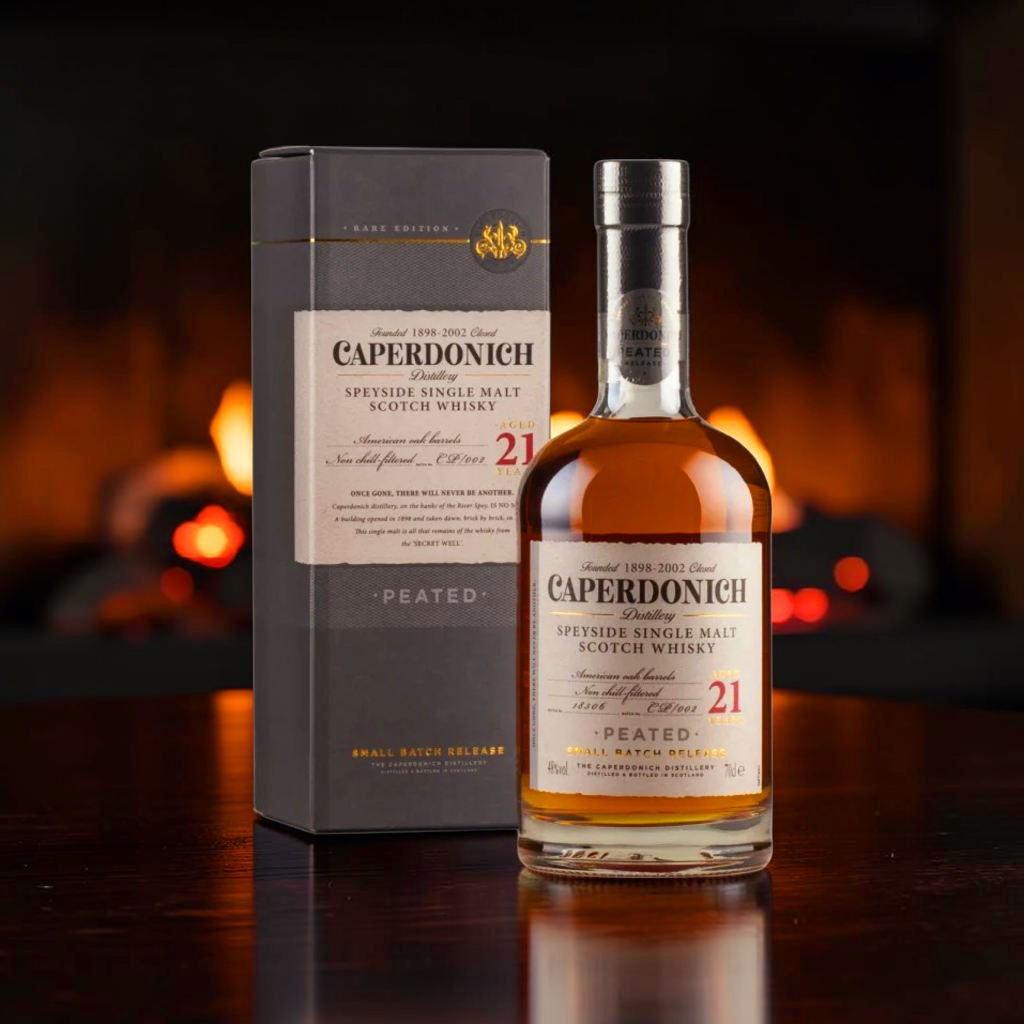
The 21-Year-Old (Peated):
The Caperdonich 21 Year Old Peated is a rare and highly sought-after single malt, primarily because the distillery itself no longer exists.
Here is a detailed description of this exceptional bottling.
A Rare Peated Speyside
Caperdonich was historically known for its light, fruity, and classic Speyside style. However, in the 1970s, it began producing a small amount of peated spirit for use in blends, making this 21-year-old peated expression a fascinating and unusual release.
Age: 21 Years Old
Cask Maturation: Fully matured in American Oak Barrels.
ABV: Typically bottled at 48% ABV
Filtration: Non-chill filtered.
The 25-Year-Old (Peated):
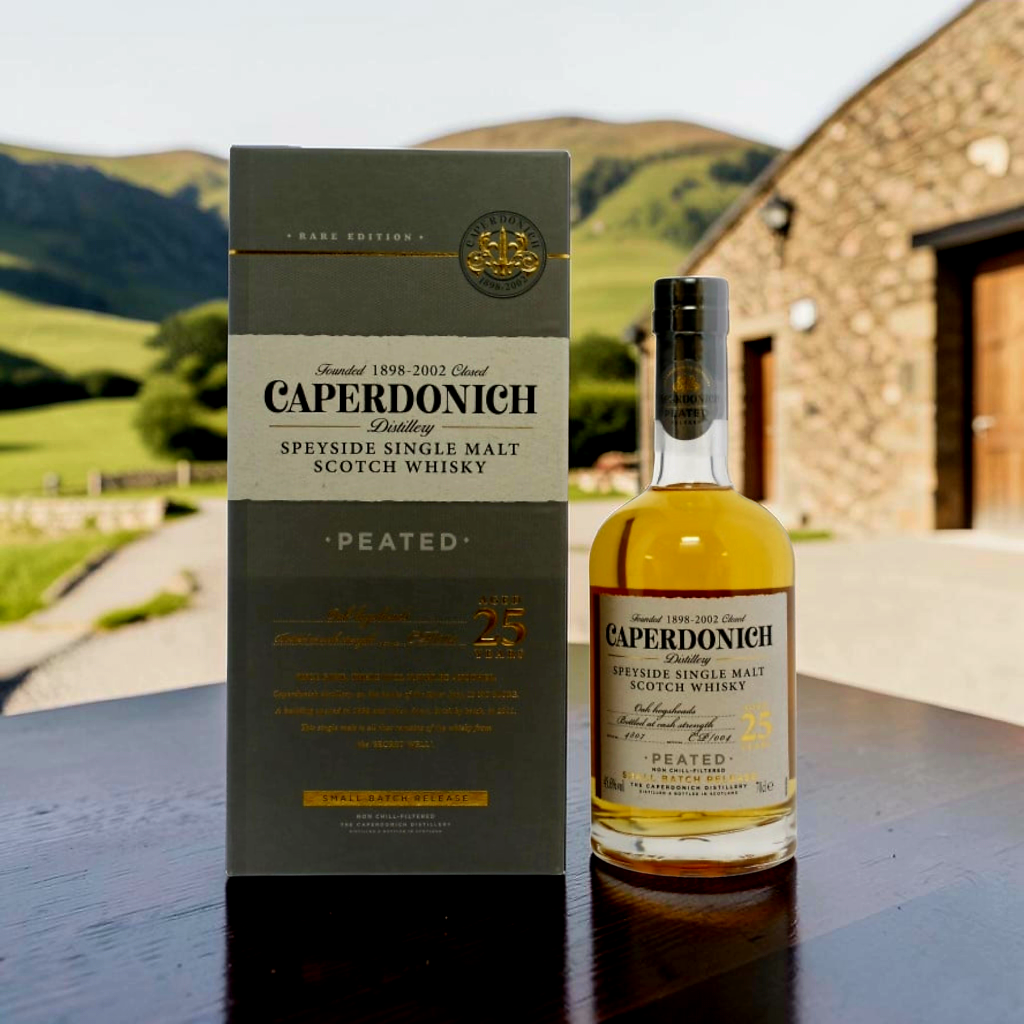
The Caperdonich 25 Year Old Rare Edition Small Batch Release is a highly sought-after expression from a legendary closed and demolished distillery (a “Ghost Distillery”), making every bottle a piece of history.
This specific release is part of the “Secret Speyside Collection” launched by Chivas Brothers (owner Pernod Ricard) to highlight rare whiskies from their often-overlooked distilleries.
Here is a detailed description of the Caperdonich 25 Year Old Small Batch:
The Expression’s Specifications:
Age: 25 Years Old.
Type: Single Malt Scotch Whisky.
Release Series: Part of the Secret Speyside Collection (Distillery Bottling).
Cask Maturation: Primarily matured in Oak Hogsheads (often Bourbon wood).
ABV: 45.6% abv.
Filtration: Often Non-Chill Filtered, preserving the whisky’s full character.
The 30-Year-Old:
The Caperdonich 30 Year Old is no longer just a luxury bottle on a shelf; it has become a landmark in modern whisky collecting. As the pinnacle of the “Secret Speyside Collection,” it represents the last great chapter of a now-demolished distillery, and in 2026 that story has gained real urgency. You are no longer simply buying a mature Speyside single malt—you are securing an official piece of liquid history from a producer that will never distill another drop.
What once sat as a high-end retail item has now moved decisively into the realm of serious collectors. The remaining official stock under Chivas Brothers has visibly tightened, with fewer and fewer bottles surfacing through traditional retail channels. Each sale today is not just a purchase; it’s a transfer of ownership of a finite, dwindling asset. When those last official casks are finally exhausted, there will be no more chances to acquire a Caperdonich 30 Year Old with this level of provenance and presentation.
The “Ghost” Vintages (Independents):
Independent bottlers hold some of the most eccentric and aged Caperdonich stocks. These are the “true” collectables for serious investors.
- Gordon & MacPhail “Private Collection” (1979/1982): G&M has some of the best remaining wood.
- Signatory Vintage 30th Anniversary: Bottled a few years ago, this 1968 vintage is a “Unicorn” bottle.
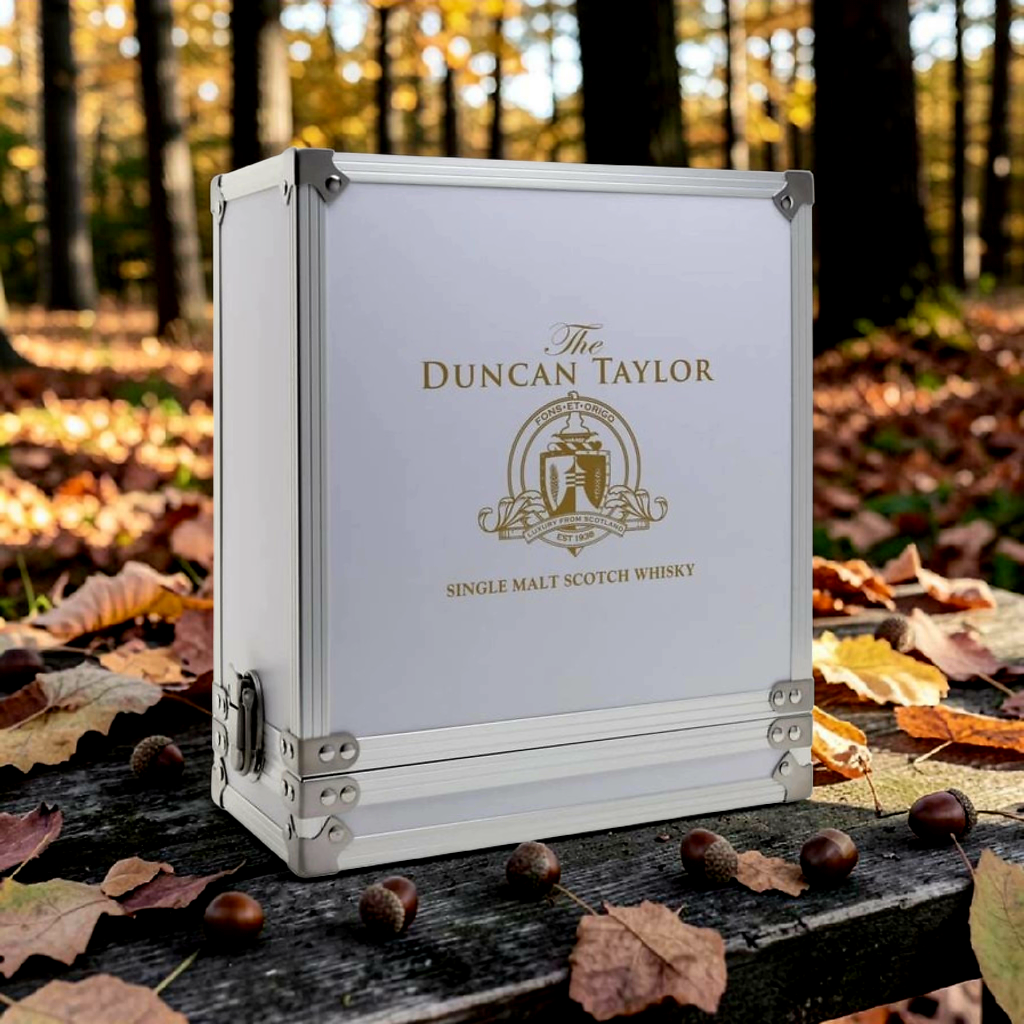
- Duncan Taylor “Rarest of the Rare” 1969 (50 Year Old): This is the pinnacle. Only a handful of these exist.
Why the 1972 Vintage is Special:
If you see a Caperdonich with a 1972 vintage, pay attention. 1972 is considered the “legendary year” for the distillery, similar to 1972 for Brora. Whiskies from this year are noted for an extraordinary tropical fruit profile (mango, passionfruit) that hasn’t quite been replicated in other years.
The “Stills” Collectable: Belgian Owl:
For a more affordable “tribute” collectable, many fans track the early releases of Belgian Owl. Since they bought Caperdonich’s actual copper stills, there is a physical lineage there. It’s a great “conversation piece” to sit next to an original bottle.
Final Words:
The final word on Caperdonich is, unavoidably, a hard one: it is gone, and it is not coming back. In an era when so-called “Ghost Distilleries” are being resurrected with glossy new facilities and carefully curated relaunches, Caperdonich stands apart. There is no modern phoenix rising from these ashes. The buildings were dismantled, the stills cut up, the site repurposed. This is not a romantic pause in production; it is true extinction.
That stark reality is exactly what gives Caperdonich its extraordinary power and allure today. When you buy or open a bottle, you are not just sampling an old Speyside; you are participating in the final chapter of a story that can never be rewritten. Every dram poured is one fewer left in the world. Every cork pulled quietly moves the distillery’s remaining liquid closer to zero.
Unlike revived names, which can always produce another limited edition or a new “heritage” range, Caperdonich has no second act waiting in the wings. What is still in casks and bottles now is all that will ever exist. That simple fact should reshape the way collectors and enthusiasts think about it. This isn’t just another old or rare whisky; it is a finite cultural artifact, a liquid snapshot of a vanished place and time.
And this is where legacy comes in. Caperdonich’s significance will not be measured by future marketing campaigns or new-age visitor centers, but by the memories it leaves behind and the care with which its remaining stock is treated. The last bottles in private collections and on retailers’ shelves are not just investments to be flipped; they are custodial responsibilities. Whether they are opened to mark life’s milestones or preserved as museum pieces for future generations, each choice helps define how Caperdonich will be remembered.
If you have ever considered adding Caperdonich to your shelf, that decision is no longer something to defer indefinitely. Every year, more of its spirit is opened, enjoyed, and gone forever. The market will not replenish itself. There will be no new vintage ten or twenty years from now. Acting while you still have the chance is not about fear of missing out; it is about recognizing that some opportunities are, by their very nature, once-only.
In the end, Caperdonich’s extinction gives its legacy a rare kind of purity. It reminds us that whisky is not just a product but a fleeting intersection of place, craft, and time. For those who value that intersection, the remaining Caperdonich in the world offers a compelling proposition: the opportunity to engage with a distillery that will never be rebuilt, through whiskies that will never be remade. When the last bottle is finally emptied, only stories and tasting notes will remain. Until then, the choice is clear—either be part of that legacy now, or watch it pass into history from a distance.
Investment Verdict:
If you’re fortunate enough to own a bottle of Caperdonich today, you’re holding far more than a simple single malt—you’re holding a piece of Scotch whisky history that cannot be recreated. The distillery is gone, the stills are silent, and no new stock will ever come to market. In investment terms, that makes your bottle part of a permanently shrinking pool of liquid, and that scarcity is the single most powerful force in driving long‑term value.
This is why the verdict is clear: hold, don’t open.