
Indian whisky is a fascinating and massive category, though it’s often a “tale of two spirits.” India is actually the world’s largest consumer of whisky, but what you find in a bottle can vary wildly depending on whether it’s a mass-market blend or a premium single malt.
History Of The Indian Whisky
The history of Indian whisky is a 200-year evolution from a colonial necessity to a global luxury powerhouse. It is uniquely defined by India’s tropical climate and its ingenious use of local ingredients.
1. The Colonial Genesis (1820s – 1880s)
The story begins with Edward Abraham Dyer (father of the infamous Colonel Dyer), who arrived in India in the late 1820s.
- The First Distillery: Dyer established the Kasauli Brewery (later a distillery) in 1820-1855, high in the Himalayas. He chose this spot because the cool climate and spring water reminded him of Scotland.
- Solan No. 1: This brand, born in Kasauli and later moved to nearby Solan, became India’s first malt whisky. It is still produced today, making it one of the oldest continuously produced whiskies in Asia.
- The “Hemp” Commission: In the late 19th century, the British government actually formed a commission to see if “hemp” (cannabis) was more harmful than Scotch, partially to clear a path for Scotch imports to the Indian elite.
2. Post-Independence & the IMFL Era (1947 – 1980s)
After 1947, India faced a dilemma: a high demand for whisky but a shortage of grain and extreme poverty.
- The Molasses Shift: To preserve grain for food, the government encouraged the production of Indian Made Foreign Liquor (IMFL). Because India was a sugar-producing giant, distilleries used molasses (sugarcane byproduct) instead of grain.
- The Giants: This era saw the rise of legendary companies like United Spirits (McDowell’s No. 1, launched in 1968) and Mohan Meakin (the makers of Old Monk and Solan No. 1).
- The Definition Gap: Because these “whiskies” were molasses-based, they were technically rums, leading to a long-standing trade dispute with the EU over the definition of “whisky.”
3. The Malt Revolution (1982 – 2004)
In 1982, Amrut Distilleries in Bangalore began experimenting with malted barley.
- The Surplus Discovery: Initially, they used malt only to “elevate” their cheaper molasses blends. By 2004, they had a massive surplus of aged malt.
- The London Gamble: Amrut’s chairman, Neelakanta Jagdale, famously launched Amrut Single Malt in Glasgow and London first. He figured if the Scots liked it, the world (and eventually India) would follow. It worked.
4. The Global Golden Age (2010 – 2026)
Since 2010, the narrative has shifted from “molasses spirits” to “world-beating single malts.”
- Jim Murray’s 97 Points: In 2010, the Whisky Bible named Amrut Fusion the 3rd best whisky in the world. This shattered the stereotype that quality whisky required a cold climate.
- The Expansion: Paul John (Goa) followed in 2012, and Rampur (Himalayas) in 2016. These brands leveraged “Turbo Aging”—where India’s heat matures whisky 3x faster than in Scotland.
- Current Dominance (2024-2026): In recent years, Indri (from Piccadily Distilleries) has taken the world by storm, winning “Best in Show” at several 2023-2024 global awards.
What Makes The Indian Whisky So Special
What makes Indian whisky special isn’t just one factor—it’s a combination of unique agriculture, an aggressive climate, and a “rule-breaking” approach to production that would be impossible in Europe.
1. The “Six-Row” Barley Factor
Most Scotch is made from two-row barley. India primarily uses six-row barley, which is grown in the northern plains of Rajasthan and Haryana.
Higher Protein/Enzymes: Six-row barley has more protein and enzymes, which creates a more robust, “huskier” spirit.
Oily Texture: It produces a spirit with a higher oil content, giving Indian single malts a distinctively creamy, buttery mouthfeel that coats the palate.
2. The Turbo Ageing
In India, whisky matures quickly due to a phenomenon often called Tropical Maturation. While a Scotch might need 12 to 18 years to mellow out, an Indian single malt can reach its “peak” in just 4 or 5 years.
The science behind this “turbo-aging” comes down to three main factors:
1. The Heat (Molecular Agitation)
Chemical reactions happen faster at higher temperatures. In India, temperatures in maturation warehouses can fluctuate between 25°C and 45°C (77°F to 113°F).
- Expanding and Contracting: The liquid inside the barrel expands in the heat and contracts when it cools. This acts like a “breathing” motion, forcing the spirit deep into the wood fibers and pulling it back out.
- Extraction: This cycle extracts the vanillins, tannins, and sugars from the oak at a much more aggressive rate than in the cool, stable climate of Scotland.
2. The “Angel’s Share” (Massive Evaporation)
In the spirits world, the liquid that evaporates through the porous wood of the cask is called the “Angel’s Share.”
- Scotland: Roughly 2% loss per year.
- India: Roughly 10–12% loss per year.
- The Result: Because so much water and alcohol are escaping, the flavors remaining in the barrel become highly concentrated. Think of it like boiling a soup—the more liquid evaporates, the more intense the flavor of what’s left behind.
3. Humidity Levels
Depending on where the distillery is located in India, humidity plays a massive role in how the whisky ages:
- High Humidity (e.g., Goa): When it’s very humid, the alcohol evaporates faster than the water. This can actually cause the alcohol percentage (ABV) of the barrel to drop over time.
- Low Humidity/Dry Heat (e.g., Northern India): Water evaporates faster than alcohol. This causes the ABV inside the barrel to increase as it ages, leading to a very punchy, high-proof spirit.
The “Rule of Three”
Distillers in India generally agree on a rough mathematical conversion for aging:
1 Year In India = 3 Year In Scotland
The Trade-off: While the whisky gets “older” faster, the distillery loses a huge amount of product. By the time a whisky hits 10 years in India, there might be nothing left in the barrel but a few liters of very “woody” liquid! This is why you rarely see Indian whiskies with high age statements (like 18 or 21 years); they simply don’t need it.
Indian Single Malt
Indian single malt has recently become a global leader. As of early 2026, Indian brands are not just competing; they are consistently outranking traditional Scottish and Japanese powerhouses in international competitions.
The rise of Indian single malt to global leadership is not a fluke—it is the result of a “perfect storm” of climatic advantages, agricultural uniqueness, and a bold, experimental distilling culture that has finally gained mainstream respect.
The brands like Amrut and Indri are currently dominating international competitions, often beating top-tier Scotch and Japanese labels.
Rank Brand Recent Achievement (2025–2026) Vibe / Profile #1 Amrut 3rd Best Whisky in the World (Jim Murray’s 2026 Whisky Bible). The Pioneer. Intense, spicy, and buttery. The Expedition (15YO) is currently India’s most expensive malt. #2 Indri Best World Whisky (Las Vegas Global Spirits Awards 2025). The Rising Star. Fruity and complex. Indri Dru (Cask Strength) and Diwali Edition are global favorites. #3 Rampur #4 Top Trending World Whisky (Drinks International 2026). The Sophisticate. Smooth and elegant. Their Asava (Indian Wine Finish) is highly influential in global bars. #4 GianChand Best Indian Single Malt (International Whisky Competition 2025). The Himalayan. Delicate, peated, and refined. A newcomer that has rapidly climbed the ranks. #5 Paul John Gold Medal (International Spirits Challenge 2025). The Coastal Master. Honeyed and tropical. The Mithuna and Zodiac series are major collector items.
Two Power Houses
In 2026, Amrut and Indri represent the “Holy Grail” of Indian whisky. While Amrut is the historic pioneer, Indri is the modern powerhouse currently sweeping global awards.
In 2026, Indri (Piccadily Distilleries) has maintained its position as a global leader in the spirits industry. The brand’s momentum from its historic 2023 “Best in the World” win has only accelerated, with its latest releases continuing to dominate major international competitions.
The “Best in the World” Moment
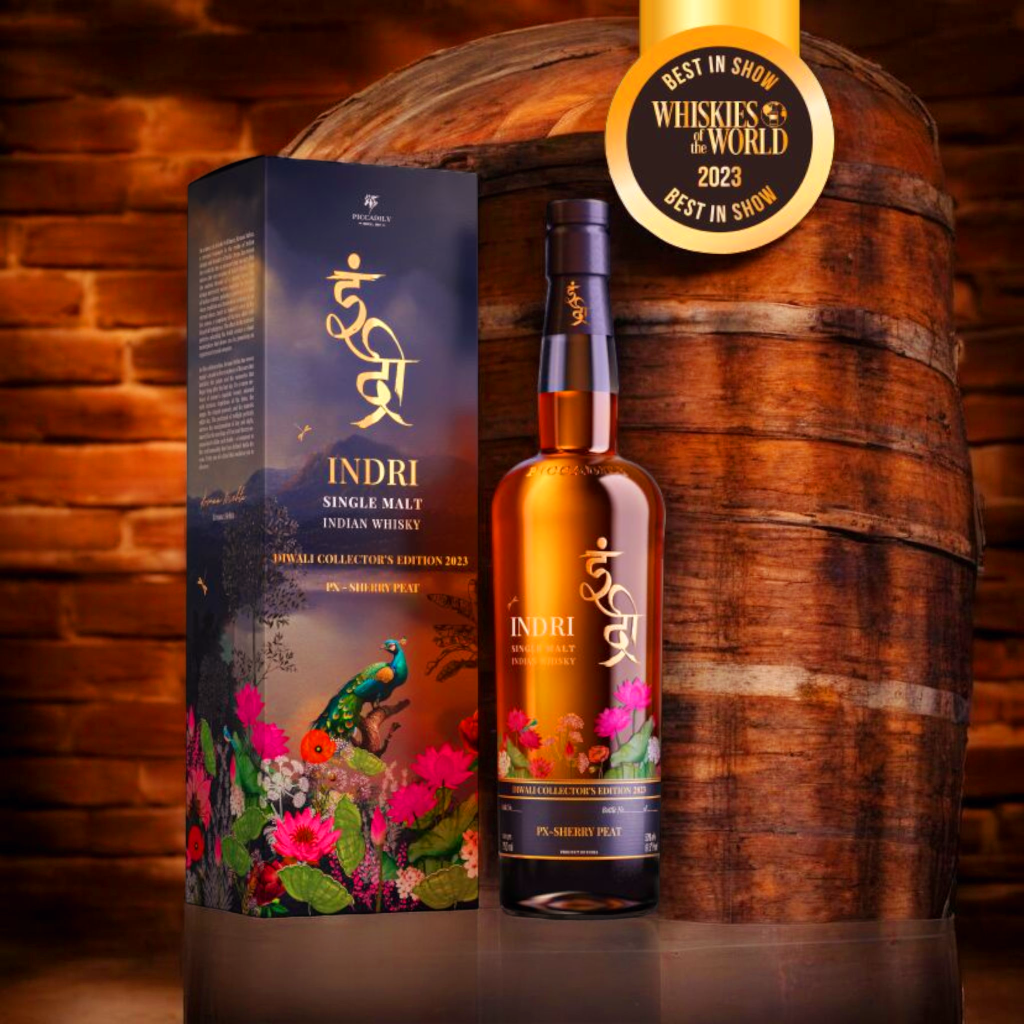
In late 2023, The Indri Diwali Collector’s Edition 2023made history at the Whiskies of the World Awards. It was named “Best in Show, Double Gold,” meaning it was blind-tasted and ranked higher than hundreds of entries from Scotland, Kentucky, and Japan. It was the first time an Indian whisky had ever taken the top spot in this specific prestigious global competition.
“World’s Best” Streak
Indri’s Diwali Collector’s Edition has become one of the most decorated whisky series in history.
- Las Vegas Global Spirits Awards (Oct 2025): The Indri Diwali Collector’s Edition 2025 (Marsala Cask Finish) was crowned “Best World Whisky” with a staggering near-perfect score of 99.1/100. This is one of the highest scores ever awarded to any whisky in the competition’s history.
- Luxury Spirits Masters 2025: Both the Diwali 2025 and the Indri Founder’s Reserve (11 Years Old) secured Gold Medals in the Ultra-Premium World Whisky category.
- Miami Global Spirit Awards 2025: Indri-Dru (Cask Strength) was named “Best World Whiskey,” outperforming legendary brands from Scotland, Japan, and the U.S.

The Future: Diversity & National Pride
As we look ahead to the rest of 2026 and beyond:
- Cultural Shift: Whisky is no longer just for the “older generation.” A younger, more diverse demographic—including a massive rise in women whisky drinkers—is driving the demand for high-end cocktails and “story-driven” craft bottles.
- Regional Pride: Whether it is the coastal malts of Goa (Paul John), the urban innovations of Bangalore (Amrut), or the mountain spirits of Jammu (GianChand), India is finally treating its whisky regions like the diverse “terroirs” they are.
Final Thoughts
In the 1800s, India imported whisky to feel British. In the 1900s, it made “whisky” from sugar to survive. In 2026, the world imports Indian whisky to experience the gold standard of modern distillation.